
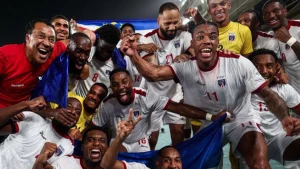
When the referee blew for full time, the score was 3-0. Cape Verde defeated Swaziland at home and, as group D winners, secured the first World Cup qualification. The National Stadium in the Cap Verdean capital Praia exploded in cheers.
The 15,000-capacity stadium was instantly overwhelmed by the blue-and-white football jerseys Fans poured from the stands onto the pitch, embraced and cried with the players. The moment that the West African country had waited 40 years for. The dream of the volcanic island state to play football came true amid the cheers of the 15,000-capacity stadium.
A historic breakthrough
In the final group D match of the Africa Qualifiers, Cape Verde took its chance.
Against Swaziland, the bottom of the table, the team scored three goals in only 47 seconds in the second half. Goals from Livramento, Semedo and Stopira triggered the most jubilant celebration in the small 540,000-inhabitant country since its 50th independence anniversary. Throughout the qualification, Cape Verde posted an impressive record of seven wins, two draws and one defeat. Even more impressive was that they conceded no goals at home.
The team, ranked only 70nd in the world, went through as group leaders directly to the next round and defeated Cameroon, the African Lions with eight World Cup appearances. Here you will find affordable football jerseys!

A small country, big dreams
Cape Verde, with only 540,000 inhabitants, has accomplished a miracle in world football.
Cape Verde will supplant Trinidad and Tobago as the smallest participant nation in the history of the World Cup and, after Iceland in 2018, will also be the second smallest by population.
For this decisive match, the Cape Verdean government declared a national holiday, which began at 12:00 noon on the day of the match, so that all citizens could witness history together. President Neves also attended the event to cheer on the national team.
A long road to ascent
Cape Verdean football’s ascent did not happen overnight. Cape Verde gained independence from Portuguese colonial rule in 1975, the Cape Verde Football Association was founded in 1982 and joined FIFA in 1986.
The turning point came in 2013, when Cape Verde reached the quarter-finals at its first Africa Cup of Nations participation, drawing international football’s attention to the Atlantic island nation.
At the Africa Cup of Nations 2023 they again reached the quarter-finals, narrowly losing to South Africa in a penalty shoot-out, thereby demonstrating their impressive strength.
The power of recruiting talent abroad
The secret to Cape Verdean football’s success lies primarily in its strategy of recruiting talent from abroad.
The Cape Verde Football Association actively seeks and recruits talent within the Cape Verdean community worldwide. Many emigrants live in European countries such as Portugal, the Netherlands, and France, whose descendants receive youth development in European leagues and rise to professional football.
In this World Cup qualifying match, all 25 Cape Verdean players come from foreign leagues, 14 of whom were born abroad. These players form the backbone of the team and lend the miracle of this small nation its strength.

Also, the Cotonou Agreement signed in 2000 between the EU and Cape Verde was a great help, as it allowed Cape Verdean players to play in European leagues without having to use quotas outside the EU, significantly improving their development opportunities.
Football, a national unity force
Cape Verde, consisting of ten volcanic islands, is resource-poor and has a unified economic model. Nevertheless, football has become a strong unifying force for the country.
When the team sets off for matches, fans line the streets to the airport to bid them farewell. When important games are imminent, the nation is in harmony.
National defender Lopez said emotionally: 'My father left home at 16. For Capverdians it is normal to go abroad in search of opportunities. But if we stick together, we can achieve extraordinary things.'
Qualification for the World Cup is not only a sporting achievement but also proof of national soft power. Just before the 50th anniversary of independence, Cape Verde has shown the world that even small countries can realise big dreams.

Conclusion
Cape Verde is expected to be in Pot 4 at the FIFA World Cup 2026 in Mexico City, but this 'Blue Shark' team will not simply be playing.
Their aim is to gain at least a point or even a draw against a top team. As Captain Pico López said: 'We play for the whole island.'
This country, made up of ten volcanic islands and without resources, has united its population through football.





 English
  German
  Croatian
  Danish
  French
  Czech
Czech  Italian
  Dutch
Dutch  Swedish
  Spanish
  Slovak
  Slovenian